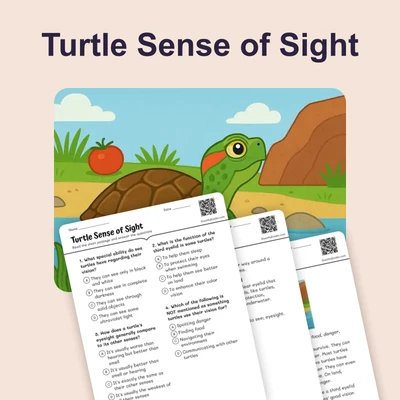

This learning resource is available in interactive and printable formats. The interactive worksheet can be played online and assigned to students. The Printable PDF version can be downloaded and printed for completion by hand.
Turtles possess a remarkably developed sense of smell that plays a crucial role in their survival and behavior. This olfactory prowess enables them to detect food, recognize potential mates, avoid predators, and even navigate vast distances. On land, turtles employ a behavior known as 'tongue-flicking,' similar to snakes, to capture scent particles from the air and transfer them to their Jacobson's organ for processing. In aquatic environments, turtles can smell underwater by pumping water in and out of their nostrils, allowing them to detect chemical cues dissolved in the water. This ability is particularly important for sea turtles, which use their sense of smell to locate their natal beaches for nesting, sometimes from hundreds of miles away. The turtle's olfactory capabilities also aid in finding suitable habitats and avoiding areas with potential dangers. Research has shown that some turtle species can detect odors at concentrations as low as a few parts per million, highlighting the sensitivity of their smell. This acute sense, coupled with their other sensory abilities, equips turtles to thrive in diverse environments, from freshwater ponds to vast oceans
CONTENT PREVIEW
Expand content preview
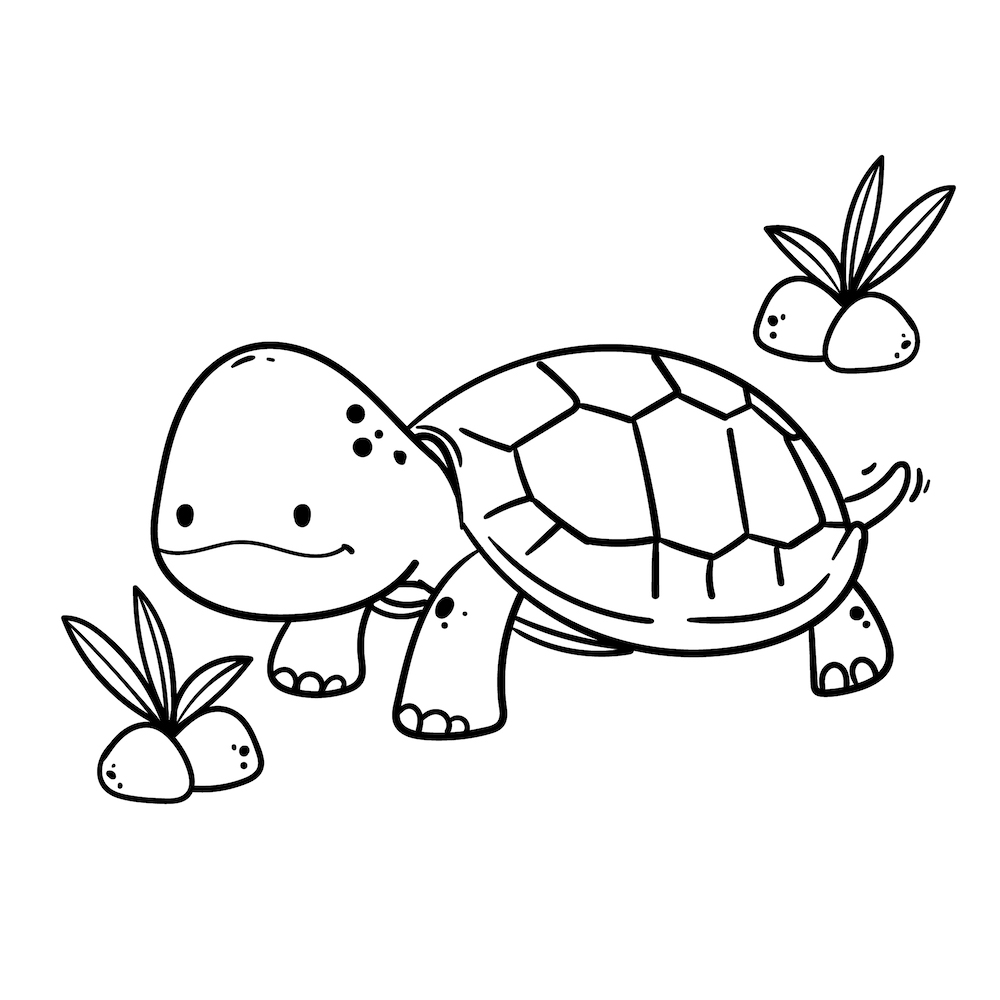
Turtles have a good sense of smell. They use their noses to find food and mates. Turtles can smell both in the air and underwater. On land, turtles flick their tongues to catch scent particles in the air. In water, turtles pump water in and out of their noses to smell. Some sea turtles can smell their home beaches from far away in the ocean. This helps them return to lay eggs.
Turtles also use smell to avoid predators and find safe places to live. Their keen sense of smell is very important for their survival.
How do turtles catch scent particles in the air on land?
By flicking their tonguesBy pumping air through their shellsBy blinking rapidlyBy extending their necks
What method do turtles use to smell underwater?
They use their tonguesThey pump water in and out of their nosesThey rub their shells against objectsThey close their eyes to focus on smells
What helps some sea turtles return to their home beaches?
Their strong leg musclesTheir ability to see long distancesTheir sense of smellTheir internal compass
Which of the following is NOT mentioned as a use for a turtle's sense of smell?
Finding foodLocating matesAvoiding predatorsRegulating body
Perfect For:
👩🏫 Teachers
• Reading comprehension practice
• Auto-graded assessments
• Literacy skill development
👨👩👧👦 Parents
• Reading practice at home
• Comprehension improvement
• Educational reading time
🏠 Homeschoolers
• Reading curriculum support
• Independent reading practice
• Progress monitoring
Reading Features:
📖
Reading Passage
Engaging fiction or nonfiction text
❓
Comprehension Quiz
Auto-graded questions
📊
Instant Feedback
Immediate results and scoring
📄
Printable Version
Download for offline reading
🔊
Read Aloud
Voice-over with word highlighting
Reviews & Ratings
No reviews yet. Be the first to share your experience!
Related Content
Informational Text—Where Do You Live?
This informational text on urban, suburban, rural areas is a great way to practice reading fluency and comprehension whi...
RI.3.10RF.3.4RF.3.4.ARL.3.1
Sharks—Informational Text
This informational text on the sharks will teach your students all about these incredible, ancient animals! Free respons...
RI.3.1RI.3.10RF.3.4RI.3.1
Health Breakfast—Author's Purpose
This informational text on the benefits of a healthy breakfast will ask students to find the main point the author is tr...
RI.2.8RI.2.10RI.2.6RI.2.1
Reading Comprehension: The Grand Canyon
This informational text on the Grand Canyon will teach your students all about this incredible wonder of the world! Free...
RI.3.1RI.3.10RI.3.4RF.3.4
Mark's Awesome Birthday Party
This fiction passage about a child's birthday party with comprehension questions will keep your students engaged. They w...
RL.3.1RL.3.3RF.3.4.CL.3.4.A
Snorkeling & Scuba Diving
RI.2.2RI.2.6RI.2.10RF.2.4.A
Analyze Visual information—The Arctic Fox
This informational text about arctic foxes is a great opportunity to practice interacting with images in a text. Student...
RI.2.7RI.2.10RI.2.1RF.2.4.A
Reading Comprehension— Storms
Practie summarizing paragraphs with this fun science informational text on storms! Students will give the main idea of t...
RI.2.2RF.2.4.ARF.2.4RI.2.10
Informational Text — Armadillos
This informational text on armadillos is a great way to practice reading comprehension. Students will read the short pas...
RI.2.1RI.2.10
Informational Text — Penguins
This informational text on penguins is a great way to practice reading comprehension. Students will read the short passa...
RI.2.1RI.2.10
The Rubik's Cube
RI.2.2RI.2.6RI.2.10RF.2.4.A
Informational Text —Elephants Facts
This informational text on elephants with comprehension questions to follow is perfect for teaching main idea. Students ...
RF.2.4.ARI.2.1RI.2.2RI.2.6
Informational Text—Tardigrades
This informational text on tardigrades will teach your students all about this strange animal! Free response comprehensi...
RI.2.1RI.2.10RI.3.1RI.3.10
Mark’s Birthday Party-Short Story
This fiction passage about a child's birthday party with comprehension questions will keep your students engaged. They w...
RL.3.1RL.3.3RF.3.4.CL.3.4.A
Monty the Moose
This short story is a great way for early readers to practice their comprehension skills. Students will read the passage...
RL.3.1RL.3.3RF.3.4.CL.3.4.A
Ants and Pheromones
This quiz is designed for 2nd and 3rd grade students to test their understanding of how ants communicate using pheromone...
RI.3.1RI.2.1
GIla Monster
The Gila Monster is a large, venomous lizard found in desert regions. It has thick, bumpy skin that is orange and black,...
RI.2.1RI.3.1
Rattlesnake
The Rattlesnake is a venomous snake that thrives in desert environments. It is easily recognized by the rattle at the en...
RI.2.1RI.3.1
Desert Scorpion Facts
The Desert Scorpion is a resilient arachnid that inhabits the desert. It has a hard exoskeleton for protection and uses ...
RI.2.1RI.3.2
The Turtle's Shell
The turtle's shell is a remarkable feature that defines these ancient reptiles. This protective structure consists of tw...