
This learning resource is available in interactive and printable formats. The interactive worksheet can be played online and assigned to students. The Printable PDF version can be downloaded and printed for completion by hand.
This fascinating passage explores space telescope technology, aligning with NGSS standards for earth and space sciences. The narrative explains how space telescopes work and why they're positioned above Earth's atmosphere. Through the description of repair missions, students learn about the maintenance challenges of space technology and the importance of astronomical observations. The passage effectively combines astronomy concepts with engineering challenges while maintaining student engagement through vivid descriptions of space images.
CONTENT PREVIEW
Expand content preview
The class gathered around a large cylinder-shaped object with a mirror-like surface and complex instruments attached to its sides. A screen nearby showed stunning images of colorful galaxies and glowing nebulas.
"This is a model of a space telescope," Alex said. "Unlike telescopes on Earth, space telescopes orbit high above our planet's atmosphere, where they can take crystal-clear pictures of distant stars and galaxies."
"How do scientists fix it if something breaks?" Tim wondered.
"Sometimes astronauts have to go on special repair missions," Alex answered. "They wear their spacesuits and float in space while making repairs. It's like doing a puzzle while swimming, except in space!"
What shape was the space telescope?
SquareTriangleCylinderSphere
Why are space telescopes put above Earth's atmosphere?
To be closer to the starsTo take clearer picturesTo save moneyTo avoid rain
How do astronauts fix the space telescope?
They bring it back to EarthThey use remote controlsThey go on repair missions in spacesuitsThey send robots to fix it
What did Alex compare repairing the telescope to?
Building with blocksDoing a puzzle while swimmingPlaying a video gameFixing a car
Perfect For:
👩🏫 Teachers
• Reading comprehension practice
• Auto-graded assessments
• Literacy skill development
👨👩👧👦 Parents
• Reading practice at home
• Comprehension improvement
• Educational reading time
🏠 Homeschoolers
• Reading curriculum support
• Independent reading practice
• Progress monitoring
Reading Features:
📖
Reading Passage
Engaging fiction or nonfiction text
❓
Comprehension Quiz
Auto-graded questions
📊
Instant Feedback
Immediate results and scoring
📄
Printable Version
Download for offline reading
🔊
Read Aloud
Voice-over with word highlighting
Reviews & Ratings
No reviews yet. Be the first to share your experience!
Related Content
Story Summary Graphic Organizer
This story analysis graphic organizer includes space to write about the main characters, setting, summary, conflict, and...
RL.1.1RL.2.1RL.3.1RL.4.1
Valentine's Day— Short Fiction Passage
This short fiction passage on Valentine's Day is perfect for reading comprehension, as well as interacting with illustra...
RL.3.7RL.3.10RL.2.1
Story Map Graphic Organizer
This story analysis graphic organizer includes space to write about the main characters, setting, summary, conflict, and...
RL.1.1RL.2.1RL.3.1RL.4.1
Story Elements Graphic Organizer
This story analysis graphic organizer includes space to write about the main characters, setting, summary, conflict, and...
RL.1.1RL.2.1RL.3.1RL.4.1
The Honey Jar—Evidence from text
This fable with comprehension questions will teach students about being truthful. Students will identify character trait...
RL.3.3RL.3.2RL.3.1RL.3.10
Story Analysis Graphic Organizer
This story analysis graphic organizer includes space to write about the main characters, setting, summary, conflict, and...
RL.1.1RL.2.1RL.3.1RL.4.1
Story Summary Graphic Organizer |
This story analysis graphic organizer includes space to write about the main characters, setting, summary, conflict, and...
RL.1.1RL.2.1RL.3.1RL.4.1
Story Graphic Organizer
This story analysis graphic organizer includes space to write about the main characters, setting, summary, conflict, and...
RL.1.1RL.2.1RL.3.1RL.4.1
Luca and Lily—Understanding Text
This short story about a trip to the animal shelter is a great way to practice comprehension. Students will read the tex...
RF.2.4.ARF.2.4RL.2.1
Andrew’s First Day of Second Grade
This short story about a boy on his first day of school is perfect for practicing character response. Students will read...
RL.2.3RL.2.10RL.2.1RL.2.5
Squirrel & Badger—Moral of the Story
This short fable is a great way to teach central lessons or morals. Students will read the passage about the badger and ...
RL.2.2RL.2.1RL.2.10RL.3.2
Froggie—Main Idea
This short fable is a great way to teach central lessons or morals. Students will read the passage about the frog who do...
RL.2.2RL.2.1RL.2.10RL.3.2
Fable —The Journey to the Witch’s House
This short fable is a great way to teach central lessons or morals. Students will read the passage about the witch who g...
RL.2.2RL.2.1RL.2.3RL.2.10
Short Story —Norah and the Fire Alarm
This short story about a girl who is afraid of the fire alarm is a great way to practice comprehension. Students will re...
RL.2.1RL.2.10
Angela and Marie—Short Story
This short story about a cat having kittens is a great way to practice comprehension. Students will read the text and th...
RL.2.1RL.2.10
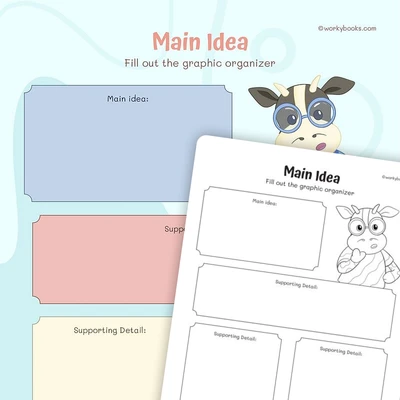
Graphic Organizer for Main Idea
This graphic organizer on main idea includes space to write the main idea and three supporting details.
RL.1.1RL.2.1RL.3.1RL.4.1
The Exciting Arrival
In 'The Exciting Arrival,' young Sarah and her classmates embark on a thrilling field trip to the Space Museum. The stor...
RL.3.1RL.2.1RL.4.1
The Solar System Room
The Solar System Room' takes readers on a journey through our cosmic neighborhood. As Sarah's class enters a dark room, ...
RL.3.1RL.2.1RL.4.2
The Astronaut's Gear
In 'The Astronaut's Gear,' Sarah and her classmates get an up-close look at real space suits and equipment. The story de...
RL.3.1RL.2.1RL.4.3
The Mars Rover
The Mars Rover' introduces young readers to the cutting-edge technology used in exploring other planets. Sarah encounter...