

Humidity: A Key Weather Variable — Reading Comprehension
Rate this|
1
Premium Resource
Present
Present in classroom. No work saved
Assign
Classroom with student accounts, Track progress
Quick Play
No student accounts, assign with a link
Grades
5
6
7
8
Standards
7.RI.7.1
PRINT+DIGITAL RESOURCE
This learning resource is available in interactive and printable formats. The interactive worksheet can be played online and assigned to students. The Printable PDF version can be downloaded and printed for completion by hand.
Humidity measures the amount of water vapor in the air and is caused by evaporation. It is measured using hygrometers and affects weather patterns, comfort, and health. High humidity makes the air feel hotter, while low humidity can cause dryness.
CONTENT PREVIEW
Expand content preview
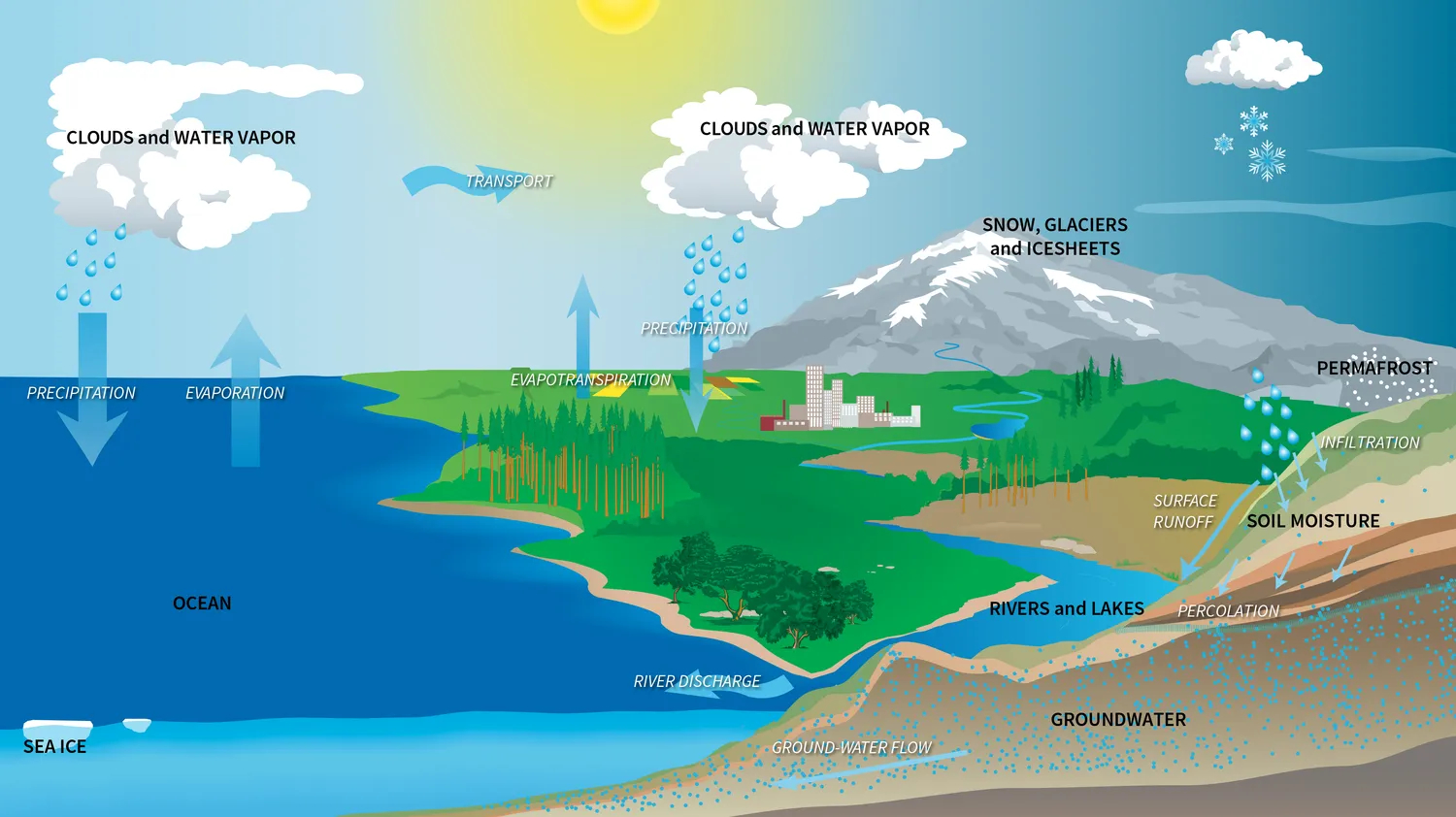
"The Water Cycle (SVS30580)" by NASA's Scientific Visualization Studio - Marit Jentoft-Nilsen, Global Science and Technology, Inc./Deborah McLean / Wikimedia Commons.
Humidity is the amount of water vapor present in the air. It is a key weather variable that affects how comfortable we feel and plays a role in weather patterns like rain, fog, and dew.
Humidity is caused by the evaporation of water from oceans, lakes, rivers, and plants. When water evaporates, it turns into water vapor, which mixes with the air. The warmer the air, the more water vapor it can hold.
Humidity is measured using a hygrometer. There are different types of hygrometers, including mechanical ones that use human hair (which expands and contracts with humidity) and electronic ones that use sensors.
The most common unit for humidity is grams of water vapor per cubic meter of air (g/m³). However, humidity is often expressed as relative humidity, which is a percentage of the maximum amount of water vapor the air can hold at a given temperature.
High humidity can make the air feel hotter because sweat evaporates more slowly, reducing the body’s ability to cool down. Low humidity, on the other hand, can cause dry skin and respiratory issues.
Fun fact: The highest humidity levels are often found in tropical regions, where warm air holds large amounts of water vapor.
What is humidity?
The amount of air pressureThe amount of water vapor in the airThe speed of the windThe temperature of the air
What causes humidity?
The evaporation of waterThe Earth’s rotationThe moon’s gravityThe sun’s heat
What instrument is used to measure humidity?
ThermometerBarometerHygrometerAnemometer
What is the most common unit for humidity?
CelsiusGrams of water vapor per cubic meter of airMillibarsInches of mercury
What is relative humidity?
The total amount of water vapor in the airA percentage of the maximum water vapor the air can holdThe speed of the windThe temperature of the air
How does high humidity affect how we feel?
It makes the air feel coolerIt makes the air feel hotterIt has no effectIt causes dry skin
What is the fun fact mentioned in the passage?
Humidity is highest in polar regionsThe highest humidity levels are found in tropical regionsHumidity is not affected by temperatureHygrometers cannot measure humidity
What is one effect of low humidity?
It makes the air feel hotterIt causes dry skin and respiratory issuesIt increases sweat evaporationIt causes rain
Perfect For:
👩🏫 Teachers
• Reading comprehension practice
• Auto-graded assessments
• Literacy skill development
👨👩👧👦 Parents
• Reading practice at home
• Comprehension improvement
• Educational reading time
🏠 Homeschoolers
• Reading curriculum support
• Independent reading practice
• Progress monitoring
Reading Features:
📖
Reading Passage
Engaging fiction or nonfiction text
❓
Comprehension Quiz
Auto-graded questions
📊
Instant Feedback
Immediate results and scoring
📄
Printable Version
Download for offline reading
🔊
Read Aloud
Voice-over with word highlighting
Reviews & Ratings
No reviews yet. Be the first to share your experience!
Related Content
Measuring Carbon Stored in Vegetation
Measuring carbon stored in vegetation is crucial for understanding climate change. Plants absorb CO₂ during photosynthes...
7.RI.7.1
Air Temperature: A Key Weather Variable
Air temperature measures how hot or cold the air is and is caused by the kinetic energy of air molecules. It is measured...
7.RI.7.1
Wind-Powered Trains In the Netherlands
The Netherlands is the first country to run all its electric trains on 100% wind power, thanks to wind farms on land and...
7.RI.7.1
Four Ways Forests Affect the Atmosphere
Forests play a vital role in regulating the atmosphere by absorbing CO₂, producing oxygen, cooling temperatures, and imp...
7.RI.7.1
Air Masses: Types and Characteristics
Air masses are large bodies of air with similar temperature and humidity. They form over specific regions and influence ...
7.RI.7.1
Cyclones and Anticyclones: A Comparison
Cyclones are low-pressure systems that bring stormy weather, while anticyclones are high-pressure systems that bring cle...