
Reading Passage

Starfish Body Parts

Interactive passage with audio narration, comprehension questions, and printable PDF.

No ratings yet|
5
Grades 1–2ElaReadingScienceEnglish · SpanishInteractive · Printable
Aligned toRI.1.1RI.1.2RI.1.8

What's included

Reading passage
Audio narration
Comprehension quiz
Writing activity
Glossary & flashcards
Differentiated version
Spanish translation

Starfish Body Parts preview and details

About this printable Starfish Body Parts science reading passage, NGSS-aligned (Grades 1-2)

Starfish, or sea stars, possess a remarkable anatomy that enables them to thrive in diverse marine environments. The body of a starfish typically consists of a central disc from which multiple arms radiate, usually five but sometimes up to 40 in some species. These echinoderms are covered in a tough, spiny skin that serves as protection against predators. One of the most fascinating aspects of starfish anatomy is their ability to regenerate lost arms, a survival mechanism that allows them to recover from injuries. Starfish lack a centralized brain but instead have a complex nervous system with a nerve ring and radial nerves extending into each arm. At the tip of each arm, they possess eyespots capable of detecting light and dark, aiding in navigation. This unique body structure, combined with their regenerative abilities, makes starfish excellent subjects for studying marine adaptations and resilience in ocean ecosystems.
Written by Neha Goel TripathiPublished by Workybooks
Preview

Sample passage and quiz from Starfish Body Parts

Reading passage and comprehension quiz preview

Starfish Body Parts

Starfish have interesting body parts. Their body is made up of a central disc and arms. Most starfish have five arms, but some can have more. On top of their body, they have a tough, spiny skin that protects them. Starfish have eyes at the end of each arm to sense light. They don't have a brain, but they have a nerve ring that helps them feel things.


 Starfish also have a special ability to grow back lost arms. This helps them survive if a predator bites off an arm.

Comprehension quiz (4 questions)

1. What are the two main parts of a starfish's body?

Head and tail
Central disc and arms
Fins and scales
Shell and legs

2. Where are a starfish's eyes located?

On its central disc
At the end of each arm
On its stomach
It doesn't have eyes

3. What helps a starfish feel things instead of a brain?

A nerve ring
Its stomach
Its spiny skin
Its tube feet

4. Why is it helpful for starfish to grow back lost arms?

To swim faster
To eat more food
To survive predator attacks
To look prettier
Curriculum

Common Core standards for Starfish Body Parts

RI.1.1

Ask and answer questions about key details in a text.

RI.1.2

Identify the main topic and retell key details of a text.

RI.1.8

Identify the reasons an author gives to support points in a text.

Who it's for

Perfect for the way you teach

Teachers
  • Build comprehension skills
  • Auto-graded quiz
  • Differentiated reading
Parents
  • Read together at home
  • Improve fluency
  • Quiet reading time
Homeschoolers
  • Reading curriculum support
  • Independent practice
  • Track Lexile growth
Topics

Reviews & Ratings

No reviews yet. Be the first to share your experience!

More reading you might love

19 more
Worksheet
Hummingbirds—Reading Fluency - worksheet educational content
Grade 1

Hummingbirds—Reading Fluency

reading informational text · RI.1.1

$1.50
Worksheet
Airplanes Informational Text - worksheet educational content
Grade 1

Airplanes Informational Text

reading informational text · RI.1.1

Free
Worksheet
Stars—Reading for Purpose - worksheet educational content
Grade 1

Stars—Reading for Purpose

reading informational text · RI.1.1

$1.50
Passage
Rainy Day-Lucy's Observation - reading educational content
Grades 1–2

Rainy Day-Lucy's Observation

reading literature · RF.1.4.A

Free
Passage
My Family - reading educational content
Grades 1–2

My Family

reading literature · RF.1.4.A

$1.50
Passage
Max and Zoe's Beach Adventure-Short Story - reading educational content
Grades 1–2

Max and Zoe's Beach Adventure-Short Story

reading literature · RF.1.4.A

$1.50
Passage
Sophie's Garden Flower-Short Story - reading educational content
Grades 1–2

Sophie's Garden Flower-Short Story

reading literature · RF.1.4.A

Free
Passage
Alex's Snowy Adventure-Short Story - reading educational content
Grades 1–2

Alex's Snowy Adventure-Short Story

reading literature · RF.1.4.A

Free
Passage
Olivia's Kite Flying Adventure -Short Story - reading educational content
Grades 1–2

Olivia's Kite Flying Adventure -Short Story

reading literature · RF.1.4.A

Free
Passage
The Weather - reading educational content
Grades 1–2

The Weather

reading literature · RF.1.4.A

Free
Passage
What Turtles Eat? - reading educational content
Grades 1–3

What Turtles Eat?

reading informational text · RI.1.2

Free
Passage
What is a Starfish? - reading educational content
Grades 1–2

What is a Starfish?

reading informational text · RI.1.1

Free
Passage
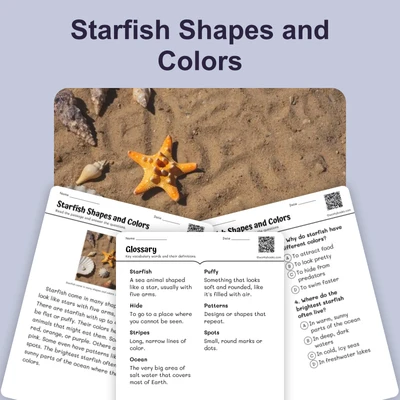
Starfish Shapes and Colors - reading educational content
Grades 1–2

Starfish Shapes and Colors

reading informational text · RI.1.1

Free
Passage
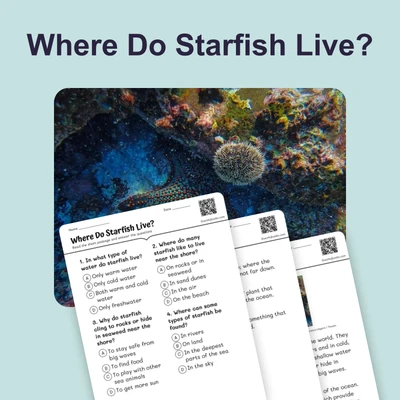
Where Do Starfish Live? - reading educational content
Grades 3–5

Where Do Starfish Live?

reading informational text · RI.1.1

$1.50
Passage
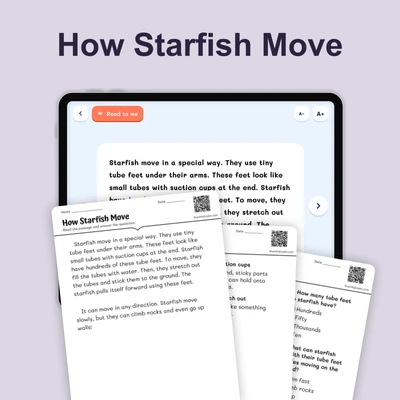
How Starfish Move - reading educational content
Grades 1–2

How Starfish Move

reading informational text · RI.1.1

Free
Passage
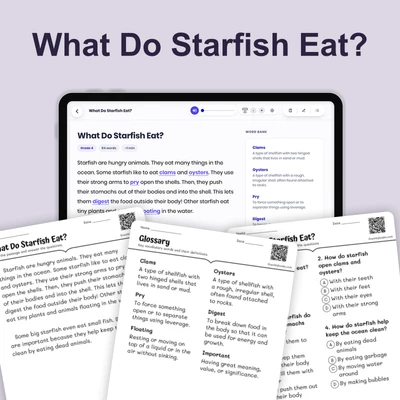
What Do Starfish Eat? - reading educational content
Grades 1–2

What Do Starfish Eat?

reading informational text · RI.1.1

Free
Passage
How Starfish Protect Themselves - reading educational content
Grades 1–2

How Starfish Protect Themselves

reading informational text · RI.1.1

Free
Passage
Starfish and Their Babies - reading educational content
Grades 1–2

Starfish and Their Babies

reading informational text · RI.1.1

$1.50
Passage
Fun Facts About Starfish - reading educational content
Grades 1–2

Fun Facts About Starfish

reading informational text · RI.1.1

Free
Copyright © 2026 Workybooks. Made with ♥ in California.